A risk-reward ratio compares how much you stand to lose on a trade to how much you stand to gain. It is arguably the most important number in your trading plan, because it determines whether your strategy can survive a normal losing streak. Get this wrong, and even a high win rate will not save your account.
The concept is simple. The execution is where most traders fall apart. They either set arbitrary targets disconnected from market structure, or they move their stops at the worst possible moment. This guide covers the math, the methods for setting realistic targets, and the mistakes that undermine even solid setups.
What a Risk-Reward Ratio Is and How to Calculate It
The risk-reward ratio (RRR) measures the distance from your entry to your stop loss (the risk) against the distance from your entry to your profit target (the reward). The formula is straightforward:
Risk-Reward Ratio = (Entry Price - Stop Loss) / (Take Profit - Entry Price)
A 1:2 RRR means you are risking one unit to gain two. If your stop loss is 50 pips away and your target is 100 pips away, your RRR is 1:2. Professional traders often express this in R multiples: a 2R trade means the potential reward is twice the risk.
Here is a concrete example. A trader buys EUR/USD at 1.0850 with a stop loss at 1.0820 (30 pips risk) and a target at 1.0910 (60 pips reward). The RRR is 30:60, or 1:2. If the trader risks $150 on the trade via position sizing, the potential profit is $300.
The ratio itself does not tell you whether a trade is good or bad. A 1:5 RRR looks incredible on paper, but if the target is beyond any reasonable support or resistance level, the probability of price reaching it may be close to zero. RRR only becomes meaningful when combined with win rate.
Win Rate vs. Risk-Reward: The Tradeoff That Defines Profitability
This is where the math gets interesting. You do not need to win most of your trades to make money. You just need the winners to be large enough relative to the losers. The table below shows the minimum win rate needed to break even at various risk-reward ratios, excluding commissions and slippage.
Breakeven Win Rate by Risk-Reward Ratio
| Risk-Reward Ratio | Breakeven Win Rate | Win 100 Trades At This Rate | Net Result (per $100 risked) |
|---|---|---|---|
| 1:1 | 50.0% | 50 wins, 50 losses | $0 |
| 1:1.5 | 40.0% | 40 wins, 60 losses | $0 |
| 1:2 | 33.3% | 33 wins, 67 losses | $0 |
| 1:3 | 25.0% | 25 wins, 75 losses | $0 |
| 1:4 | 20.0% | 20 wins, 80 losses | $0 |
| 1:5 | 16.7% | 17 wins, 83 losses | $0 |
Study that table carefully. With a 1:3 risk-reward ratio, a trader only needs to be right about 25% of the time to break even. Win 30% of the time at 1:3 and you are solidly profitable. Win 40% of the time at 1:2 and you are building real equity.
This is why RRR matters more than win rate for most strategies. A system that wins 35% of its trades sounds terrible until you realize each winner returns 3R. Over 100 trades risking $100 each: 35 winners at $300 = $10,500 in gains, minus 65 losers at $100 = $6,500 in losses. Net profit: $4,000. That is a 40% return on risk capital, from a strategy that loses nearly two out of three trades.
The inverse is also true. A system with a 70% win rate and a 1:0.5 RRR (risking twice what it targets) will bleed money. Over 100 trades risking $200 to make $100: 70 winners at $100 = $7,000 in gains, minus 30 losers at $200 = $6,000 in losses. Net profit: just $1,000 on $20,000 in total risk, and one bad streak wipes out months of gains.
How to Set Realistic Profit Targets
The worst thing a trader can do is pick an arbitrary multiple and apply it to every trade. "Always target 2R" sounds disciplined but ignores what the market is actually doing. Targets should come from market structure, not round numbers. Here are three methods that work.
Support and Resistance Levels
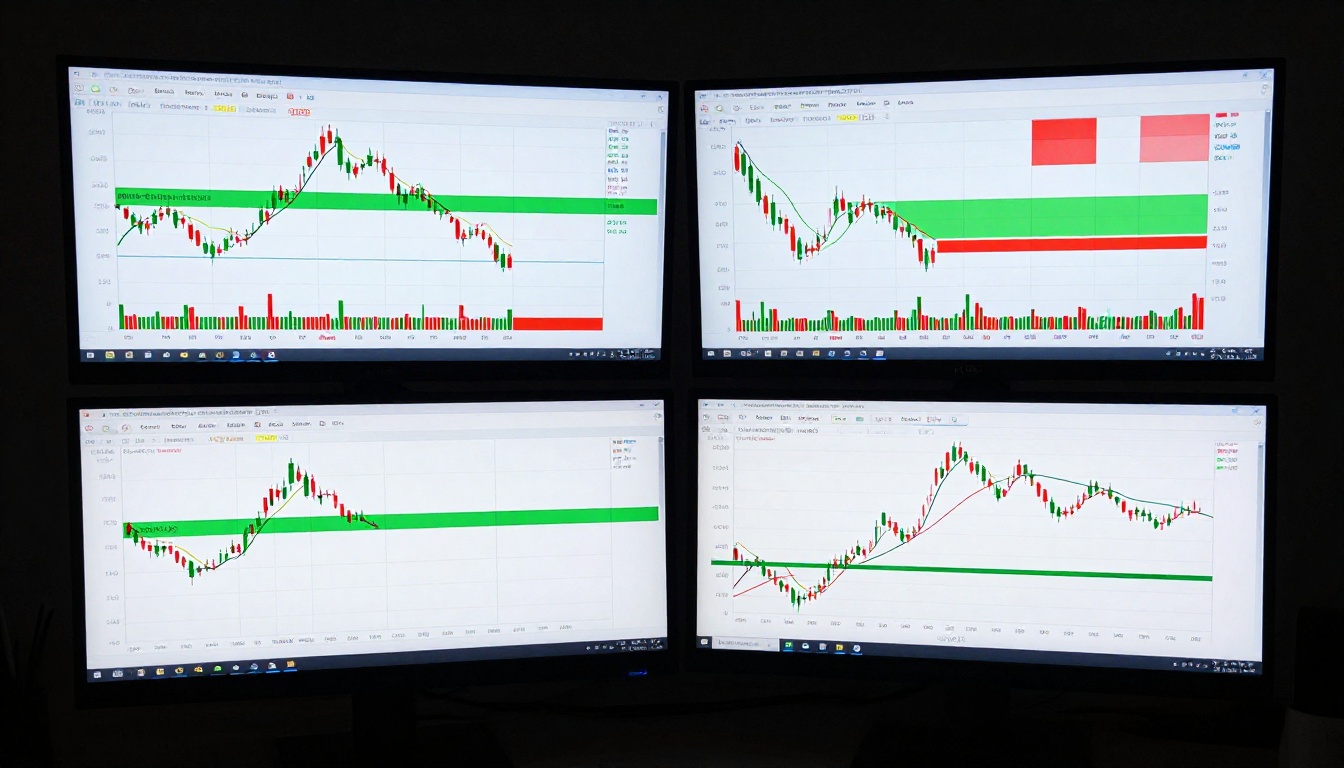
The most reliable targets are price levels where the market has previously reversed or stalled. If you are long, the next significant resistance level is a logical target. If the nearest resistance is only 1R away but the next one is 2.5R away, you have a decision to make: take the higher-probability small target, or aim for the lower-probability larger one.
The key is that your target should be just inside the level, not right on it. Markets often reverse a few pips or points before reaching the exact level. A target set at the S/R level itself will frequently miss by a fraction.
Measured Moves
Chart patterns often project targets based on the size of the pattern itself. A head and shoulders pattern projects a move equal to the distance from the head to the neckline. A bull flag projects a move equal to the preceding flagpole. These measured moves are not guarantees, but they provide structure-based targets that are better than arbitrary multiples.
ATR-Based Targets
The Average True Range (ATR) measures how much an instrument typically moves in a given period. Setting targets as a multiple of ATR ensures your expectations align with what the market is actually capable of. If the daily ATR on gold is $25 and you are targeting a $100 intraday move, that is four times the average range, which is unrealistic for a day trade.
A practical approach: use 1.5x to 2.5x the ATR for swing trade targets, and 0.5x to 1x the ATR for day trade targets. This keeps expectations grounded in actual volatility rather than wishful thinking.
Common Ratios in Practice
Different trading styles naturally gravitate toward different RRR profiles. The ratio is not just a preference; it is a function of timeframe, holding period, and how much room the market gives you.
Typical Risk-Reward Ratios by Trading Style
| Trading Style | Typical RRR | Required Win Rate (to profit) | Why This Ratio Fits |
|---|---|---|---|
| Scalping | 1:1 to 1:1.5 | 45-55% | Tight targets, high frequency, costs eat into small R |
| Day Trading | 1:1.5 to 1:2.5 | 30-45% | Room for structure-based targets within the session |
| Swing Trading | 1:2 to 1:4 | 25-40% | Multi-day holds allow larger targets at key levels |
| Position Trading | 1:3 to 1:10 | 15-30% | Weeks/months of trending moves, wide stops |
Scalpers typically operate at lower RRR because their edge comes from win rate and volume. They take many small wins and keep losses equally small. Trying to force a 1:3 RRR on a scalping strategy usually just means the target never gets hit.
Swing and position traders can afford lower win rates because their holding period allows price to make larger moves. A swing trader holding a position for five days has much more room than a day trader who needs to close by the session end.
The Trap of Arbitrary Targets
"Always use a 2:1 reward-to-risk" is one of the most repeated pieces of trading advice, and one of the most dangerous when applied mechanically. Here is the problem: the market does not care about your ratio.
If you buy a stock at $50 with a stop at $48 (risk = $2) and apply a rigid 2R target at $54, but there is a major resistance level at $53, you are ignoring the structure that actually governs price behavior. The smarter play is to target $52.80 (just below resistance) for a 1.4R trade, or skip the trade entirely if the RRR is not attractive enough.
The correct process works in the opposite direction from what most beginners assume. You do not start with a desired RRR and then set targets to match it. Instead:
- Identify your entry based on your setup
- Place your stop loss based on where the trade idea is invalidated
- Identify the target based on market structure (S/R, measured moves, ATR)
- Calculate the resulting RRR
- Take the trade only if the RRR meets your minimum threshold
This process is a filter, not a formula. It eliminates trades where the structure does not support a favorable ratio, which is exactly what it should do. A trader who skips low-RRR setups is exercising discipline, not missing opportunities.
Beyond Fixed Targets: Trailing Stops and Partial Exits
Fixed targets are clean and simple. You set the level, price hits it, the trade is done. But they leave potential profit on the table when a trade wants to run further. Two alternatives can improve outcomes in trending conditions.
Trailing Stops
A trailing stop follows price as it moves in your favor, locking in profit along the way. Methods include trailing by a fixed number of points, by ATR (e.g., 1.5x ATR behind the current price), or by moving the stop to the most recent swing low (for longs) or swing high (for shorts). The tradeoff: trailing stops capture big moves but get stopped out of trades that pull back before continuing.
Partial Profit-Taking
Rather than all-or-nothing exits, many traders scale out in portions. A common approach is to take half the position off at 1R (locking in some profit and reducing risk) and let the remainder run with a trailing stop toward 2R or 3R.
Partial Exit Example: 100 Share Position, $2 Risk Per Share
| Exit Stage | Shares Closed | Exit Point | Profit on Partial | Running Total |
|---|---|---|---|---|
| Entry | 0 | $50.00 (entry) | $0 | $0 |
| Partial exit at 1R | 50 | $52.00 | $100 | $100 |
| Move stop to breakeven | 0 | Stop moved to $50.00 | $0 | $100 (risk-free) |
| Remaining at 2.5R | 50 | $55.00 | $250 | $350 |
| Blended R-multiple | - | - | - | 1.75R total |
The blended result (1.75R on the full position) is lower than if the entire position reached 2.5R, but the trade became risk-free after the first partial. That psychological benefit keeps traders in positions they might otherwise exit too early out of fear.
The downside: in trades that hit 1R and then reverse, you only capture half the potential 1R profit rather than locking in the full amount at a fixed 1R target. Partial exits reduce variance in both directions.
How RRR Connects to Position Sizing
Risk-reward ratios and position sizing are two halves of the same framework. Position sizing controls how much money you risk per trade (typically 1% of your account). RRR determines what you expect to earn for that risk.
Consider a $50,000 account using the 1% rule. That is $500 of risk per trade. At a 1:1 RRR, the expected value of each trade depends entirely on win rate. But at a 1:3 RRR with a 35% win rate, the expected value per trade is:
(0.35 x $1,500) - (0.65 x $500) = $525 - $325 = $200 expected profit per trade
Over 100 trades, that is $20,000 in expected profit, or a 40% return on the account. This is the power of combining disciplined position sizing with a favorable risk-reward profile. Neither element works well without the other. A great RRR is meaningless if you risk 10% of your account and blow up on a losing streak. A disciplined 1% risk is insufficient if your RRR does not generate enough expected value to justify the effort.
Common Mistakes
Most RRR-related errors fall into a few predictable categories. Recognizing them is the first step toward avoiding them.
Moving stop losses further away after entry. This is the single most destructive habit. A trade that was 1:2 becomes 1:1 or worse when the stop is widened. If the original stop placement was correct, moving it invalidates the entire trade thesis. If the original stop was too tight, the issue is in the planning, not the execution.
Setting targets beyond the next major level. Targeting 3R when there is heavy resistance at 1.5R means price has to punch through a significant barrier to reach the target. The probability of that happening is much lower than the raw RRR suggests. Always map out the levels between entry and target.
Ignoring the RRR before entering. Many traders enter based on a signal or pattern and only think about targets afterward. This leads to trades where the stop loss is reasonable but no attractive target exists. The RRR calculation should happen before the entry order is placed, not after.
Chasing high RRR at the expense of probability. A 1:10 RRR sounds exciting, but most 1:10 setups have win rates well below 10%, making them net losers. The RRR and win rate must be evaluated together. An honest assessment of how often a given setup reaches its target is more valuable than an impressive ratio on paper.
Applying the same ratio to every market and timeframe. Volatility, liquidity, and typical range all vary by instrument. A 1:2 ratio using a 20-pip stop on GBP/JPY is very different from a 1:2 ratio using a 20-pip stop on EUR/CHF. The stop and target sizes should reflect the instrument's character, and the RRR should emerge from that analysis.
Key Takeaways
The risk-reward ratio is not a target to aim for; it is a filter for deciding which trades are worth taking. Let market structure set your targets, then calculate the ratio to see if the trade deserves your capital.
- A 1:2 RRR means you only need to win about 34% of your trades to break even. A 1:3 RRR drops that threshold to 25%.
- Targets should come from support and resistance levels, measured moves, or ATR, not arbitrary multiples.
- Calculate RRR before entering a trade, not after. If the structure does not support a minimum ratio, skip the setup.
- Never move stop losses further away to "give the trade room." If the stop needs to be wider, the position size needs to be smaller.
- Partial exits and trailing stops can improve the risk profile of winning trades, at the cost of reduced profit on trades that reverse after a partial fill.
- RRR and position sizing work together. A favorable ratio only translates into account growth when combined with disciplined risk per trade.
Disclaimer: This content is for educational purposes only and does not constitute financial advice. Trading involves substantial risk of loss. Past performance does not guarantee future results.