Every trader who stays in the game long enough will face a losing streak that tests their discipline, their confidence, and their account balance. This is not a matter of skill or strategy quality. It is a statistical certainty. The traders who survive are the ones who understand the math behind consecutive losses, recognize the emotional traps that follow, and have a plan for managing both.
Losing Streaks Are Not a Bug. They Are a Feature.
Most traders intellectually accept that not every trade will be a winner. But very few internalize what that actually means in practice. A strategy with a 60% win rate — genuinely profitable over hundreds of trades — will produce streaks of five or more consecutive losses on a regular basis.
The math is straightforward. The probability of any single trade losing with a 60% win rate is 0.40. The probability of five losses in a row is 0.40^5 = 0.01024, or roughly 1 in 98. That sounds rare until you consider how many sequences of five trades occur in a year. A day trader placing 200 trades per year has roughly 196 overlapping sequences of five trades. The expected number of five-loss streaks in a year is approximately two.
Probability of Consecutive Losses by Win Rate
| Win Rate | 3 in a Row | 5 in a Row | 7 in a Row | 10 in a Row |
|---|---|---|---|---|
| 40% | 21.6% | 7.8% | 2.8% | 0.6% |
| 50% | 12.5% | 3.1% | 0.8% | 0.1% |
| 60% | 6.4% | 1.0% | 0.16% | 0.01% |
| 70% | 2.7% | 0.24% | 0.02% | 0.001% |
That table shows the probability of any given sequence of trades being a streak. But across hundreds of trades, even the low-probability events become near-certainties. A 60% win rate trader taking 250 trades a year should expect at least one run of seven straight losers at some point in their career. The question is not whether it will happen, but what they do when it does.
The Emotional Spiral: From Frustration to Account Destruction
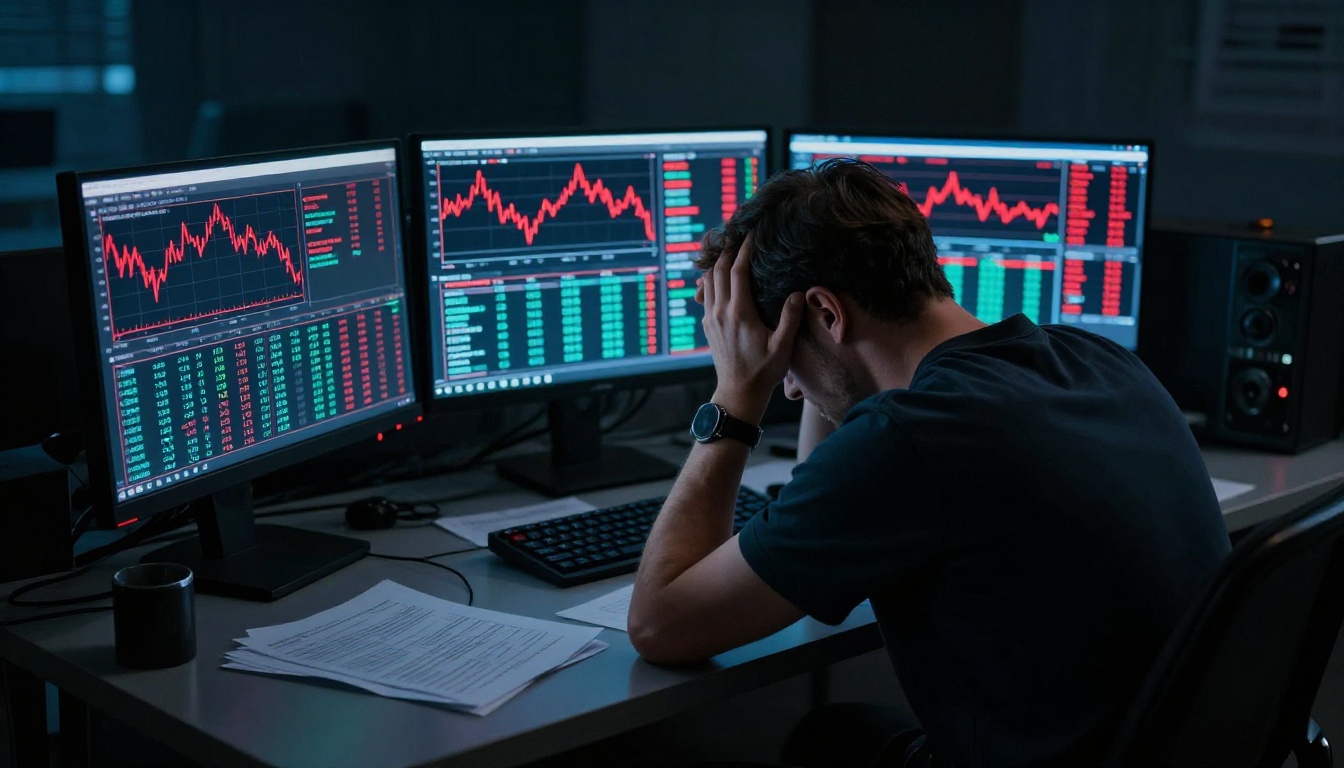
The danger of a losing streak is not the financial loss itself — assuming proper position sizing, a string of losers should be survivable. The danger is what happens inside the trader’s head. Losing streaks trigger a predictable emotional sequence that, left unchecked, converts a manageable drawdown into an account-ending catastrophe.
The spiral typically follows a pattern. The first two or three losses feel normal. By the fourth, frustration sets in. By the fifth or sixth, the trader begins to question their strategy, their analysis, and themselves. This is the inflection point where decisions stop being driven by process and start being driven by emotion.
The Emotional Spiral of a Losing Streak
| Stage | Losses | Emotional State | Typical Behavior | Risk Level |
|---|---|---|---|---|
| 1. Normal | 1-2 | Calm, accepting | Following the plan | Low |
| 2. Friction | 3-4 | Frustrated, impatient | Widening stops, forcing entries | Moderate |
| 3. Tilt | 5-6 | Angry, desperate | Revenge trading, over-sizing | High |
| 4. Spiral | 7+ | Panicked, defeated | Abandoning strategy, gambling | Critical |
The compounding problem is that each stage makes the next more likely. Frustration leads to poor trade selection, which leads to more losses, which deepens frustration. Without intervention, the cycle accelerates until the account is damaged beyond easy recovery.
Tilt: Borrowed from Poker, Deadly in Trading
Poker players call it "tilt" — the state where emotional reactions override rational decision-making. The term has migrated to trading for good reason. The psychology is identical. A poker player on tilt starts playing hands they would normally fold, raising when they should check, chasing losses with increasingly reckless bets. A trader on tilt does the same: entering trades without proper setups, sizing up to "make back" losses, and ignoring signals that would normally keep them out of the market.
What makes tilt so destructive is that the trader often does not recognize it in real time. The emotional brain is running the show, but it tells a convincing story about why this next trade is different, why the position size needs to be bigger, why the stop loss should be wider. Research in behavioral finance consistently shows that people in emotional states genuinely believe they are thinking rationally. The trader on tilt is not choosing to be reckless — they are rationalizing recklessness as strategy.
Recognizing tilt requires honest self-awareness and, ideally, external checkpoints. Common warning signs include: taking trades outside normal hours, skipping pre-trade analysis, checking P&L obsessively, moving stops after entry, and feeling a physical urgency to place a trade. If any of these sound familiar during a drawdown, the rational response is to step away. The emotional response is to keep trading. That tension is the entire problem.
The Five Behavioral Traps
Losing streaks expose specific psychological vulnerabilities. Understanding them by name makes them easier to catch.
1. Revenge Trading
The most common and most destructive trap. Revenge trading is the impulse to immediately re-enter the market after a loss, driven by the desire to "get back" what was taken. The trade selection deteriorates because the motivation has shifted from executing a strategy to recovering money. Studies of retail trading accounts consistently show that the trade immediately following a loss has a lower win rate than the trader’s baseline — not because the market changed, but because the trader did.
2. Doubling Down (Martingale Thinking)
After a string of losses, the temptation to double position size on the next trade is powerful. The logic feels sound: the probabilities have to revert, and a bigger position means a bigger recovery. This is the gambler’s fallacy applied to trading. Each trade is independent. The market does not owe a win because the last five trades lost. Increasing size during a drawdown is the fastest way to convert a 10% drawdown into a 40% drawdown.
The math on drawdown recovery is unforgiving. A 10% drawdown requires an 11.1% gain to recover. A 20% drawdown needs 25%. A 50% drawdown demands a 100% gain — doubling the remaining capital — just to get back to breakeven.
Drawdown Recovery Math
| Drawdown | Account Value (from 0,000) | Gain Needed to Recover | Dollar Gain Required |
|---|---|---|---|
| 5% | ,500 | 5.3% | 00 |
| 10% | ,000 | 11.1% | ,000 |
| 20% | ,000 | 25.0% | ,000 |
| 30% | ,000 | 42.9% | ,000 |
| 40% | ,000 | 66.7% | ,000 |
| 50% | ,000 | 100.0% | ,000 |
The highlighted row tells the whole story. Once a trader has lost half their account, they need to double what remains to get back to where they started. Doubling down during a losing streak is how traders reach that point.
3. Abandoning the Plan
After several consecutive losses, traders often conclude that their strategy is "broken" and start making discretionary changes: moving take-profit levels, widening or tightening stops, adding filters that were never backtested, or switching timeframes mid-trade. The problem is that these changes are not based on data — they are based on fear. A strategy that has been validated over hundreds of trades does not become invalid because of a streak that falls within its expected statistical variance.
4. Strategy Hopping
Related to abandoning the plan, but more extreme. After a drawdown, the trader discards their entire approach and switches to something completely different — often whatever is currently being promoted online or whatever produced the last winning trade they saw. Strategy hopping guarantees that a trader never accumulates enough data to validate any single approach. Every strategy has drawdown periods. Switching strategies during those periods means the trader only ever experiences the drawdowns and misses the recoveries. A trader choosing between scalping, day trading, and swing trading should make that decision based on their personality and schedule, not on which one had the best recent results.
5. Paralysis and Avoidance
Not all responses to losing streaks involve trading more aggressively. Some traders freeze entirely — missing valid setups because they are afraid to pull the trigger, second-guessing every signal, or avoiding the markets for weeks. While less immediately destructive than revenge trading, paralysis erodes confidence and can cause a trader to miss the exact trades that would have ended the drawdown naturally.
How Professional Traders Handle Drawdowns
Professional traders and institutional risk managers treat drawdowns as a process management problem, not an emotional one. Their approach is characterized by pre-defined rules that remove real-time decision-making during the most psychologically vulnerable moments.
Position Size Reduction
The most common professional response to a drawdown is to reduce position size, not increase it. Many proprietary trading firms enforce automatic size reductions at specific drawdown thresholds — for example, cutting position size by 50% after a 10% drawdown and by 75% after a 15% drawdown. This serves two purposes: it slows the rate of capital loss, and it reduces the emotional intensity of each subsequent trade. Trading smaller during a drawdown also allows the trader to continue executing their strategy and gathering data without the pressure of large dollar amounts at stake.
Rules-Based Circuit Breakers
Many professional traders use pre-defined circuit breakers: if daily losses exceed a specific threshold, they stop trading for the day. If weekly losses exceed a larger threshold, they reduce size or pause for the week. These rules are established during calm periods and followed during turbulent ones. The key is that the decision is already made before the emotional state compromises judgment. Common thresholds include: a daily loss limit of 2-3% of account equity, a weekly loss limit of 5-6%, and a mandatory review period after any 10% drawdown.
Systematic Trade Review
After a losing streak, professional traders review each trade against their original criteria. The question is not "did this trade win or lose?" but "did this trade follow the plan?" If the losing trades were valid setups that simply did not work out, the strategy is intact and the streak is statistical noise. If the losing trades involved deviations from the plan — poor entries, ignored signals, oversized positions — the problem is execution, not strategy. This distinction matters enormously because the corrective action is completely different.
The Role of a Trading Journal
A trading journal is the single most effective tool for surviving losing streaks. Not because writing things down is therapeutic (though it can be), but because it creates an objective record that the trader can review without the distortion of memory and emotion.
An effective trading journal records, at minimum: the date and instrument, the setup and entry reason, the entry and exit prices, the position size and risk amount, whether the trade followed the plan, and the trader’s emotional state before, during, and after the trade. That last field is the most valuable during a losing streak, because it creates a pattern recognition system for tilt. When a trader can look back and see that their last three losses all had "frustrated, felt like I had to trade" in the emotional state column, the diagnosis becomes obvious.
The journal also provides hard evidence during the recovery phase. Instead of relying on the feeling that "nothing works anymore," the trader can look at actual data: win rate over the last 50 trades, average risk-reward ratio, percentage of trades that followed the plan, and whether the current drawdown falls within historical norms. Numbers cut through emotional narratives.
When to Step Away from the Screen
Knowing when to stop trading temporarily is a skill that separates professionals from amateurs. It is not a sign of weakness. It is risk management applied to the most unpredictable variable in the trading equation: the trader themselves.
Consider stepping away from the screen when any of these warning signs appear:
- Taking trades that do not meet the written criteria of the trading plan
- Increasing position size after a loss without a systematic rule justifying it
- Feeling physical agitation — elevated heart rate, jaw clenching, rapid breathing — while watching price action
- Checking the P&L of open positions more than once per hour
- Rationalizing why "this trade is different" from the plan
- Trading outside of normal market hours or in instruments that are unfamiliar
- Experiencing difficulty sleeping due to open positions or recent losses
- Moving stop losses further from entry after the trade is open
A useful protocol is the "two-strikes" rule: if two of the above signs appear in a single session, close the platform and take at least a four-hour break. If three or more appear, do not trade for the rest of the day. These rules need to be written down and committed to before a losing streak begins — not decided in the heat of the moment.
Tying It All Together: Position Sizing as the Foundation
Every aspect of surviving a losing streak ultimately traces back to position sizing. A trader risking 1% of their account per trade can absorb ten consecutive losses and still have 90% of their capital intact. A trader risking 5% per trade will lose 40% of their account in the same streak — entering the drawdown zone where recovery becomes psychologically and mathematically brutal. The 1% rule is not just a risk management technique. It is a psychological survival mechanism. Small position sizes keep individual losses small enough that the emotional response stays manageable, which keeps decision-making rational, which keeps the strategy intact.
The relationship between position sizing and psychology is circular and reinforcing. Proper sizing reduces emotional intensity, which reduces the likelihood of tilt, which reduces the likelihood of impulsive over-sizing, which protects the account, which keeps emotional intensity low. The reverse is equally true: oversized positions create anxiety, which triggers tilt, which leads to even larger positions, which accelerates losses. Getting the technical analysis right matters, but it matters far less than getting the risk management right.
Key Takeaways
The traders who survive losing streaks are not the ones who avoid them — that is impossible. They are the ones who have planned for them in advance, who reduce size instead of increasing it, and who treat their own psychology as a variable that requires active management.
- A 60% win rate strategy will produce five or more consecutive losses multiple times per year. This is normal, not a sign that the strategy is broken.
- The emotional spiral from frustration to revenge trading to blowup follows a predictable pattern. Recognizing it early is the most important skill.
- Tilt — emotional decision-making disguised as rational analysis — is the primary mechanism by which manageable drawdowns become catastrophic ones.
- Professional traders respond to drawdowns by reducing position size, enforcing circuit breakers, and reviewing trades against plan criteria, not by trading harder.
- A trading journal with an emotional state field creates an objective early warning system for tilt.
- Position sizing at 1% or less per trade is the foundation that makes everything else possible. Without it, even the best psychological discipline cannot save an account from a bad streak.
Disclaimer: This content is for educational purposes only and does not constitute financial advice. Trading involves substantial risk of loss. Past performance does not guarantee future results.